






"No pork, no lard" is a claim about two ingredients. Halal certification is an audit of a whole kitchen. They are not the same thing, and the gap between them is where most confusion sits.
If you are trying to work out whether a bakery is genuinely halal-certified — ours or anyone else's — here is how to check it yourself in about two minutes, and what the certificate actually covers once you find it.
What certification actually covers
In Malaysia, halal certification for food is issued by JAKIM at federal level, or by the state Islamic religious authority. It is assessed against MS1500, the Malaysian Standard for halal food.
The part people underestimate is the scope. MS1500 does not stop at the ingredient list. An audited kitchen is assessed on:
- Ingredients, including every additive, flavouring and processing aid, traced to their own certification
- The premises — layout, cleanliness, and separation from anything non-halal
- Equipment, and whether it is ever shared with non-halal production
- Storage and transport, all the way to the customer
- Staff and process, including training and documented procedures
This is why a bakery can use no pork and no lard and still not be certifiable. A single uncertified vanilla extract, or one shared mixer, is enough.
How to check any bakery yourself
Malaysia has a public register. You do not need to take anyone's word for it, including ours.
- Go to the official Halal Malaysia portal at halal.gov.my, or the e-Halal directory at myehalal.halal.gov.my.
- Search the company name, not the brand name. These are often different — a café trading under one name may be registered under a holding company.
- Check the scope and the expiry date. Certification is time-limited and has to be renewed.
Two things worth knowing before you search. Certification is issued to a premises, not to a brand — so a chain with several outlets may have some certified and some not. And only the JAKIM or state-authority logo counts. Foreign halal logos are recognised only where JAKIM has approved the issuing body, and that recognition can be withdrawn.
The ingredients that usually fail
If you are reading a label rather than a register, these are the ones that most often disqualify an otherwise ordinary dessert.
Alcohol in flavourings
Real vanilla extract is vanilla steeped in alcohol — that is the definition of the product. It is the single most common reason a European-style pastry kitchen cannot certify without reformulating. Almond, lemon and coffee extracts have the same problem.
Gelatine
Used in mousses, glazes, panna cotta and most mirror finishes. It is an animal product, and unless it is specifically certified, its source is unknown. Bovine gelatine is not automatically halal either — it depends on how the animal was slaughtered.
Emulsifiers
E471, mono- and diglycerides of fatty acids, appears in a great deal of commercial baking. It can be plant-derived or animal-derived, and the label rarely says which.
Cheese and rennet
Traditional rennet is an animal enzyme. Relevant to anything cheesecake-based, which in Malaysia is most of a dessert menu.
Shared equipment
Not an ingredient, but it fails audits more often than ingredients do. A kitchen that produces both halal and non-halal items on the same line cannot certify the halal ones.
Online bakeries are a harder question
Walk into a shop and you can look for the certificate on the wall. Order online and you cannot see the kitchen, the storage, or who handled the box.
This is a fair thing to be cautious about. Our own view is that an online bakery has more to prove than a physical one, not less — which is why the register matters. A shop that is certified will be findable in it. A shop that describes itself as "halal-friendly", "pork-free", or "Muslim-owned" is telling you something real, but it is not telling you it has been audited.
Where Elevete stands
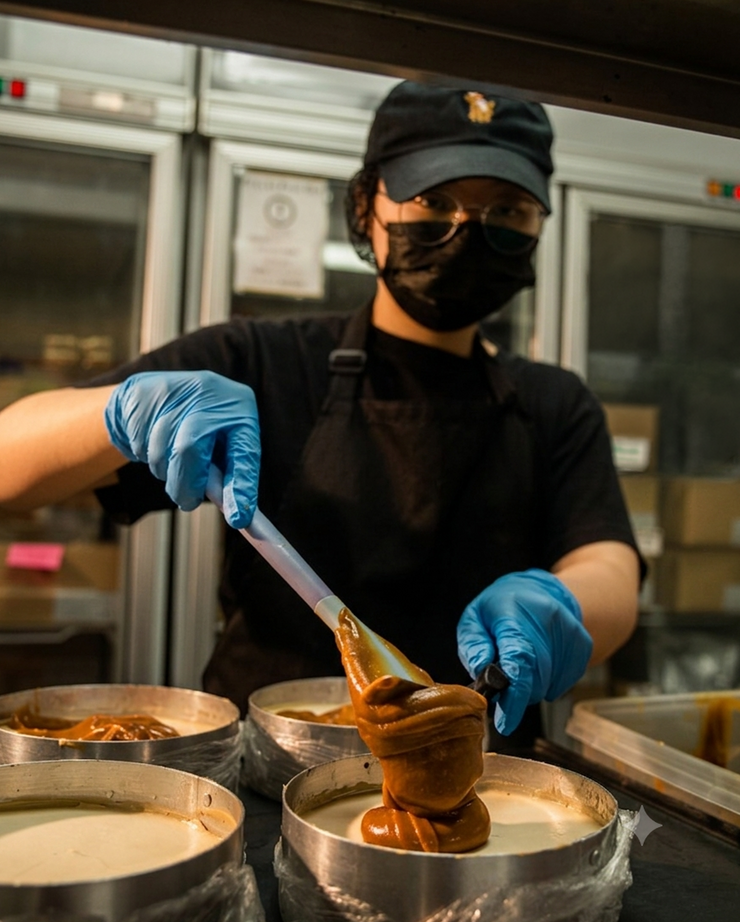
We are halal-certified. Every cake, tart, macaron and dessert we make is produced in one certified kitchen — we do not run a separate non-halal line, so there is no "which items are halal" question to answer.
Getting there meant replacing ingredients rather than just checking them. Alcohol-based extracts went first. Every gelatine, emulsifier and dairy ingredient had to come with its own certification, from a supplier who could produce it on request.
Apply the steps above to us. That is the point of a public register.
A short version
- "No pork, no lard" is not certification. It is a claim about two ingredients, not an audit.
- Certification covers the whole kitchen — premises, equipment, storage, transport and staff, not just what goes in the bowl.
- It attaches to premises, not brands, and it expires.
- You can check it yourself on the official register, in about two minutes.
- The usual failure points are alcohol-based extracts, gelatine, emulsifiers, rennet, and shared equipment.
If you would rather skip the research, everything in our full range is made in the same certified kitchen — including the Malaysian Flavour Series and every birthday cake we deliver.